 Corporate Advisory | MaxGrowth Consultants
Corporate Advisory | MaxGrowth Consultants
Starting a business as a private limited company can provide a structured legal framework for ownership, management and future growth. In Pakistan, company incorporation is regulated by the Securities and Exchange Commission of Pakistan (SECP) under the Companies Act, 2017 and the applicable regulations.
SECP has digitized the company incorporation process through its eZfile platform, making it possible for promoters to complete the incorporation process online.
At MaxGrowth Consultants, we assist entrepreneurs and businesses with company incorporation, corporate compliance, taxation, accounting and related advisory services.
Under the Companies Act, 2017, two or more persons associated for a lawful purpose may form a private company. Where only one member forms a private company, it is referred to as a single member company.
A private company provides a formal corporate structure in which ownership is represented through shares and the company operates as a separate legal entity subject to applicable corporate laws and regulations.
Entrepreneurs may choose incorporation for a number of business and commercial reasons, including:
The appropriate business structure depends on the nature, size and objectives of the business.
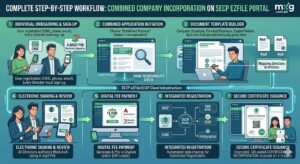
SECP’s current incorporation process is end-to-end digitized. An application for name reservation and incorporation can be submitted separately or as a combined application through eZfile.
The first step is to choose a suitable name for the proposed company.
SECP provides an online company name search facility, and promoters should ensure that the proposed name complies with the applicable requirements.
Where using the combined incorporation process, proposed names are submitted in order of priority and SECP considers the availability and acceptability of the proposed name under the applicable law.
Tip: Before finalizing a business name, promoters should consider not only name availability but also whether the proposed name accurately reflects the intended business activities.
The incorporation process is initiated through SECP’s eZfile platform.
The applicant creates a user account and provides the information required by SECP. The proposed subscribers and relevant persons may need to complete the required user registration and authentication procedures.
The incorporation application requires information concerning the proposed company, its subscribers/directors, share capital and other particulars required by SECP.
The information should be prepared carefully because errors in names, CNIC/passport details, addresses, shareholding or business activities can result in queries or the need for correction.
The Memorandum of Association sets out important matters relating to the company, including its principal business objects.
The Articles of Association contain provisions relating to the internal management and administration of the company.
These documents should be prepared in accordance with the applicable legal requirements and the intended ownership and management structure.
After the required information and documents have been entered, the incorporation application is electronically signed and submitted through the SECP system.
SECP’s process requires the relevant subscribers/promoters to complete the prescribed authentication/signing requirements.
The applicable incorporation fee depends, among other things, on the nominal share capital of the proposed company. SECP provides an online incorporation fee calculator to help determine the applicable registration fee. Additional applicable charges may also arise, such as name availability-related fees.
Promoters should therefore calculate the applicable government fees before submitting the application.
After submission and payment, the application is reviewed by SECP.
SECP may:
Applicants should monitor their eZfile account for updates and any response required from their side.
Once the incorporation process is successfully completed, SECP issues the digitally signed Certificate of Incorporation.
According to SECP’s current FAQ, the certificate is sent to the company through email and can also be downloaded through the eZfile account.
SECP’s system is integrated with the Federal Board of Revenue (FBR) for company NTN registration.
Information provided during the incorporation process is forwarded to FBR, and the NTN is issued where the required information is complete and accurate.
This integration can simplify the initial registration process, although companies may still have additional tax registrations, filings and compliance obligations depending on their business activities.
Although requirements can vary depending on the structure and circumstances of the proposed company, promoters should generally be prepared with information such as:
The exact requirements should be checked against the current SECP forms and applicable regulations before submission.
A name may appear available but still be subject to SECP’s legal requirements and approval process.
The company’s stated business activities should properly reflect the intended operations.
Incorrect CNIC, passport, address or other particulars can cause unnecessary delays.
The ownership ratio and number of shares should be carefully reviewed before submission.
Incorporation is only the beginning. A company is required to comply with applicable corporate, tax and other regulatory requirements after registration.
Once the company is incorporated, management should establish an appropriate compliance framework.
Depending on the company’s activities, post-incorporation matters may include:
The exact obligations depend on the company’s size, structure and nature of business.
MaxGrowth Consultants provides professional support in company incorporation and corporate matters advisory, together with taxation, accounting and audit services.
Our corporate advisory support can assist entrepreneurs with:
Our objective is to help entrepreneurs establish the right corporate structure and maintain compliance as their business grows.
Incorporating a private limited company in Pakistan has become more convenient with SECP’s digital eZfile system. However, successful incorporation requires accurate information, appropriate documentation and compliance with the applicable corporate laws and regulations.
For entrepreneurs, the incorporation decision should be considered as part of a broader business plan covering ownership, taxation, accounting, regulatory compliance and future growth.
MaxGrowth Consultants can assist businesses from the incorporation stage through ongoing corporate, tax and financial compliance.
Contact MaxGrowth Consultants for professional assistance with company incorporation, SECP compliance, taxation, accounting and corporate advisory services.
MaxGrowth Consultants
Corporate Advisory | Taxation | Accounting & Audit
Website: www.mxg.com.pk
Email: info@mxg.com.pk
Phone: 0092 300 78883322
Disclaimer: This article is intended for general informational purposes and does not constitute legal, tax or corporate advice. Requirements, fees and procedures may change. The applicable SECP requirements should be verified for the relevant date and circumstances before submitting an incorporation application.